

The recent PBS documentary The American Revolution spent some time in the life of the Continental soldiers. This was not an easy task. Armies moved mostly by walking. They faced adverse weather and terrain. Rations were poor. Clothing was poor. Weaponry was poor. Then there were the usual battles with all their gory aftermath. Yet if these soldiers had not accepted this challenge, American history would be much different. Strange that the founding fathers deemed these men not worthy of the vote.
I have been promoting Tiered Democratic Governance (TDG) for almost seven years on Medium. For the lukewarm fans I have encountered, I get a sense that: “You have some great ideas, Dave. But call us when you get this democracy built. We will join you then.”
Building the TDG is much easier than being a Continental soldier.
And you need not be a young or strong person to be an early TDG builder.
Starting off
The early TDG builders need not have much experience in governance to start building the TDG. Just a desire to build something new — and better — and learn some new skills for this future democracy.
In brief, this new democracy has no political parties, elects people of good character and capacity for governance, and employs consultative decision-making techniques.
I have written an essay about the six steps to start this new democracy.
In brief, the early builders can learn about these new skills by reading my books and blog. And they can read for free from my website.
This current essay will take those initial six steps into putting those skills into practice.
So let’s assume that you found three or more neighbors to work with you on this new democracy. Here is what you do next.
Writing the Local TDG Constitution
Set your living room for the meeting. Plan to meet one evening every two weeks. Set about 90 minutes for these meetings.
Download and print the sample constitution of Riverbend USA. Some early TDGs will plagiarize the template, changing only a few parts to fit their neighborhood. Other early TDG builders will use the sample constitution as a guide — and rewrite the 50 or so clauses after serious discussion, using mostly their own words. And others will build something totally different. And that is OK as long as they follow the four salient features of TDG governance.
Designate one person as the writer. The writer will gather the thoughts of the meeting — and put the words on paper. The writer will submit a draft by email. Two weeks between meetings should be enough time for the writer to prepare and send the draft. I recommend an email discussion before the next meeting.
If you are a Medium writer, you have the skills for this constitutional writing. If you have some college training, you have the skills for this writing.
The template is good example of the style of wording. You can adapt to this quasi-legal style.
Remember that this constitution is about your local TDG governance. You need not get into any discussion about the Supreme Court or a Senate or how the police arrest a citizen. Those details will come later in the TDG’s evolution. Just think local for now, getting the rules to define membership, electing the executive committee, and setting some boundaries for that committee. The 50 or so clauses around local TDG governance will be a sufficient challenge for these first months.
While the constitution is important in itself, the more important purpose is to build your group’s consultation skills. So writing the TDG constitution becomes the forum to practice and enhance consultation skills for TDG governance.
Unlike so many other political issues, you and your fellow builders should not be hung up on any of the constitutional clauses as a being life-or-death or the-sky-is-falling. There won’t be fistfights about whether the annual election is in the spring or fall. You won’t threaten a my-way-or-the-highway to get your recommendation of a 60% supermajority implemented. The clauses in the TDG constitution should not generate that kind of passion.
Rather that passion will go into acquiring the skills for TDG governance. Have a good discussion about each clause. Everyone gives their opinion. See where it goes. Here are my guidelines:
1) If consensus is attained, great. You can move forward.
2) If not, can the minority give consent to try out the majority’s direction?
3) If consent is not given, let some reflection time transpire to see if minds will change. Move to the next clause to allow for reflection for the current clause.
Let me explain “reflection” with this example. Your group has been finding consensus on Clauses #1 to #6. Just when you think you have acquired this new consultative culture, Abigail puts up resistance on Clause #7. Three of you want to go a certain way; Abigail wants to go another way. There does not seem to be any meeting of the minds.
Have some civil discussion around Clause #7. When the discussion seems to be going around in circles, maybe it’s time to postpone #7 for further reflection. The writer can draft both positions. Move onto Clause #8.
And maybe after reflection, a new solution might come forth that addresses the concerns of Abigail. No one saw this solution during the previous discussion. Consultation is often magical when you let it work.
4) If minds are not changed after reflection, then have a vote. A majority vote will provide the decision. Please realize that neither the majority nor the minority have any special powers to know how a decision will turn out. In some cases, your group will need to try some new things out and see how they work. If they don’t work out, have confidence you will fix things.
I estimate it will take you about six months to get your TDG Constitution ready. Take your time for you are also building a culture. That culture will be passed down to future TDG workers.
Ratify your constitution
You will know when the constitution has reached its final draft. It is time to try out this TDG governance idea out. It is time to officially ratify the document as your local TDG’s charter.
“Official” is perhaps not the word we should use. At this point, the TDG has no legal standing. But have a formal gathering anyways, a little vote from the builders, and a celebration. It is important to acknowledge the work that went into this document. Now the rules are in place to hold your first election.
The group that put this document together should be its first members. Do not look to increasing members after the ratification and before the first election. Remember, the TDG is about the members knowing something about the people they are voting for. Working together on the constitution is a great test of how people will approach the next stage of TDG affairs.
After ratification, some TDG builders will reflect on the last six months. They might see this ratification as a sign that the TDG is no longer some theoretical concept. Ordinary people can indeed build this new democracy.
Hold your first election
However the rules were constructed, they should be followed. Make sure all the props (i.e. voters’ list, paper ballots, ballot boxes, etc.) are there to conduct a legitimate election.
Hopefully, the early builders are holding to the “no campaigning” culture the TDG requires. If you think a TDG builder seems to be campaigning, there is no need to mention it. Just vote for someone else.
When the voting is done, count the ballots as per the rules. Determine those members who will constitute the first executive committee.
Preparing oneself for the electoral result
I have prepared a 2x2 paradigm for this first election. All builders should mentally prepare themselves for the results of that election before the election.
The first axis of this paradigm is the builder’s preferences for further involvement in the TDG. Some builders will want to continue this kind of volunteer work. Other builders will be happy to assign this work to someone else.
The second axis of the paradigm is the election results: either the person is elected or is not.
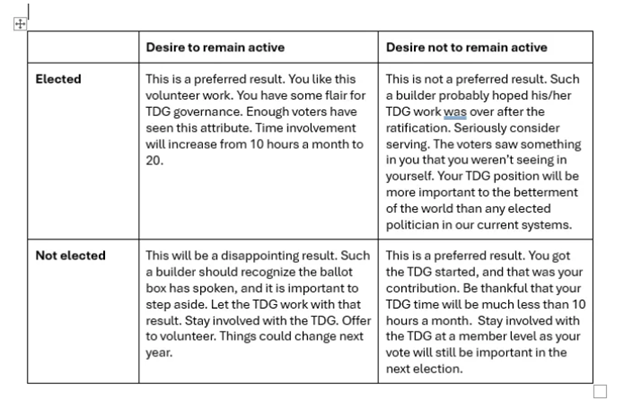
Working on the Executive Committee
After the election, much of the affairs of the local TDG reside with the executive committee. By now, the new executive committee should have established a reasonable consultative culture — because all or most of them have worked on writing the constitution.
The executive committee should assess how the first election went. What went right? What went wrong? Can the wrongs be fixed with decisions solely from the executive committee? Or does the constitution need to be changed? If a constitutional change is required, the executive committee will provide a solution, then set up a formal meeting to ask the membership for approval, using the due process in your constitution.
As well as the post-election analyses and reforms, the executive committee should also embark on a couple of other paths.
First is to increase membership. How should the TDG approach your neighborhood? Should it be quite open as to what is happening? Or should it be more subtle, with casual conversations with select neighbors? I bring this up because the world has many toxic people — and bringing in too many toxic people might upset the peaceful nature the TDG has acquired. Each local TDG will have different challenges in this matter, so each executive committee will make their own decisions. In time, the entire neighborhood will be brought into the TDG, but a slow increase in membership might be a better path.
Second is to assist neighboring TDGs. Your experience could save them a few months of development time. This help will be the beginning of the TDG Advisory Board which will become more formal later.
The electoral analyses, increasing membership, and assistance are all important. But these activities also give more practice for learning consultation, for we still have so much to learn. The goal is to make consultation a cultural trait of the TDG, not something that whimsically comes and goes — as what happens in the non-TDG world.
BTW, I have prepared a consultation workshop.
Time commitment for the TDG executive committee will increase to 20 hours a month. Some members of the executive committee may have this time and willingness to work these volunteer hours (and maybe more). Some will find attending meetings enough of a challenge. No one should be forced into more TDG activities than they can handle. There might be other TDG members who want to volunteer with the decisions made by the executive committee. This committee will learn how to recognize its resources and how best to implement them.
Merging TDGs
Many stand-alone TDGs are great. But the ultimate goal is to bring all these TDGs under one TDG umbrella. This will be done by merging TDGs.
When two adjacent TDGs have acquired some stability, they should consider merging. Each executive committee will appoint TDG members to the merging committee.
The two merging committees will meet as one committee. One of their first tasks will be to understand the constitution and culture of the other TDG. Because the two TDGs started independently, there will be some differences that need addressing. Ideas can be exchanged and reflected on.
Eventually the merging committee should start drafting a new constitution to reflect the merged area. They will present their draft to the two executive committees for refinement. If the two executive committees approve, they should offer the final decision to their membership. There should be a formal meeting and vote of the membership, as per the rules of the respective TDG constitutions. When the membership of both TDGs approves of the new constitution (with some transitional clauses), the current constitutions will no longer be applicable.
Criticism of the Mergers
To many readers, this merging process might seem a daunting task. Making these kinds of rule changes is not exciting to many people. And, too often, those who get involved in rule changes tend to fight for their own ideas, making the process a burden on the other members. Rule changes are something most organizations tend to avoid, even if changes are needed.
I will just make the following points to address this valid criticism:
1) The more toxic people will not be part of the TDG at this time. They won’t be bringing their rigid ways of thinking into TDG deliberations.
2) The TDG issues are seemingly inconsequential to the non-TDG world. So the merging details should not entice life-or-death, sky-is-falling, or hair-on-fire approaches to resolving TDG issues.
3) The TDG elections will already be finding its more capable members to lead the TDG. The TDG members will trust this leadership.
4) By the time mergers are considered, the consultative culture will be somewhat in place in both TDGs. It’s likely that most issues in the differing TDG constitutions will be resolved and worked into acceptable wording.
5) And this new constitution will be experimental. Nobody knows for sure how it will work out. The new executive committee will deal with any rough edges later.
When these five attributes, the merging will happen much quicker than our current democratic culture can imagine. I estimate that each member of the merging committee will spend 20 volunteer hours drafting the new constitution.
I will elaborate on #3 a bit more. I’m a realist: many TDG members will likely have not read the new proposed constitution, let alone studied it well. Yet they will vote in favor because they trust the executive committee to conduct the negotiations that led to the merger and its new constitution. This trust was earned, not freely given. This is so important.
Occasionally, the membership will not accept the new merged constitution. In these cases, it is important to understand that this setback is an excellent example in applying TDG governance. The executive committee needs to understand the reasons the merged constitution was not approved. In many cases, it will only be a few things that need addressing, so the merger needs a little extra work. Always follow your rules about due process.
In some cases, maybe the next election might find more capable people for this task.
After the first merger, I believe most early TDG builders will realize that this TDG is something much better than western democracy. And it is possible to govern a society in a TDG way. They will finally find the internal reasons to continue to work on the TDG.
And remember, each merger is an opportunity to practice consultation skills. These skills will be so important later in the TDG development.
The first TDG stage
I have described the first of four stages of TDG development. I call it the Early TDG.
Many of the early TDG builders just want to do democracy differently. Building the TDG gives them this purpose.
These people will come from different economic backgrounds, occupations, economic classes, educations, races, religions, genders, and whatever else separates us. They will learn how to find unity in many TDG issues, despite their differences.
Here are the characteristics of the early TDG builders:
1. An understanding of how broken our democracies are, especially the American version.
2. An understanding the popular suggestions for democratic change will not give the results we want, even if they can be changed.
3. A willingness to put 10 hours a month to build a new democracy.
So how do you fit in with these three criteria?
Is not 10 hours a month an easier sacrifice than being a Continental soldier?
Published on Medium 2025
Meet My Former City Councillor, Ray
They Say You Want a Revolution
