

Mona Lazar wrote an article about dirty old men:
Why the Dirty Old Man Trope Just Won't Die
This link will not likely work unless you a Medium member
Mona provided an interesting insert to her article:
There’s a big misunderstanding here: it’s okay to want whatever it is you want. It’s not okay to act on it. A point lost on some dirty old men.
Something from the back of my mind came to the front.
Before I tell you of my mind transfer, I had written another article that kind of relates to this article: I had a promiscuous roommate.
If you do not want to read this story, I shall summarize it. I estimate my roommate had sex with 200 different women each year. He was a successful player. While he never forced himself on any woman, he saw nothing wrong with casual sex with many partners.
In the original article, I show that he was not a liberated, liberal thinker, free of sexual taboos invented by religion. He was misogynist and women were for his conquest and pleasure. And 200 women a year complied.
The Zoroastrian Connection
About 25 years ago, I met my first Zoroastrians in Prince Rupert, B.C. They seemed like nice people, so I decided to study this obscure religion a little more. Zoroaster is the prophet/founder of the Zoroastrian Faith. While history is a bit confused about the origins and development of this religion, a main tenet of Zoroaster’s teachings is:
Good thoughts, good words, good deeds.
Let’s take stealing as an example. You know, taking things that do not belong to you. If we think about stealing, we are more likely to start talking about stealing. With such talk, we find other people who think the same way. We socialize. We reinforce our thinking. And eventually, we accept stealing as an acceptable occupation. So we steal and see no problem with it.
But if we stop stealing at the “thought” level, the “stealing words” and “stealing deeds” do not materialize in our lives. Zoroaster’s lessons on stealing are reasonably easy to connect the flow of thought to action. Thoughts are so important.
For most of us, however, the sex drive is indeed more powerful than our stealing drive. At least, I’m finding things that way.
Mona’s insert into her article suggests that “Two out of three ain’t bad!” And maybe we should acknowledge this accomplishment. Keeping our desire only in our head is progress.
But Zoroaster says we need to work a little harder.
Here’s why!
The Liberal Cabinet Ministers
In 2015, Justin Trudeau was elected prime minister of Canada. When he set up his cabinet, he had more female ministers than any other prime minister: almost 50%!
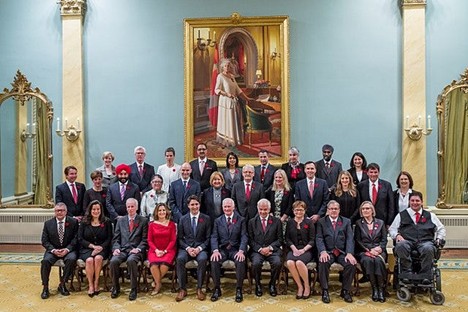
A formal portrait of the 2015 Canadian Federal Cabinet: Wikipedia
From my side of the TV screen, these female appointees seemed capable ministers. They were well-spoken, could articulate complicated things, and knew how to handle the media. Somehow, their previous occupations had prepared them to be cabinet ministers. And most likely, they had to be super prepared. Male cabinet ministers could afford a few flubs now and then, but female cabinet ministers would be judged harshly for one flub.
Now I will dive into territory where the woke crowd will want to shut me down. Hopefully, these readers can reach the end of this essay.
All of these cabinet ministers were classy women. They dressed much better than your average $30,000-a-year female worker could ever hope to dress. These cabinet ministers could afford their expensive closets with their MP or previous occupation salaries. And unfortunately, they needed to dress well to earn and retain a political occupation. Male politicians have a much easier appearance and wardrobe to manage for public life.
So why do males and females have such different expectations of their appearance? Here is my list of reasons:
1. The male and female genders are hardwired to present themselves differently, regardless of time and culture. Women like to appear feminine; men like to appear masculine. Whatever those terms mean, I cannot exactly say. I think high-heeled shoes and fancy nails are impractical to the point of silliness.
2. There are cultural expectations of how males and females present themselves. Going too far away from those expectations means some degree of societal alienation. For politicians, it means being unelected.
3. The fashion and clothing industry has shaped our values — just like the tobacco industry used to shape our values with smoking. Being in fashion, we might feel better about ourselves, but is this not a shallow happiness? Women might have been led in this psychological direction more than men. This influence is, of course, more for the fashion industry’s profit rather than for any betterment of society. I should add that we men have our own silly pursuits that put profits in other peoples’ pockets.
4. We are a sexualized culture. Part of these expressions, expectations, and fashions are designed to appeal to the opposite gender. We should acknowledge that this appeal is more sided toward women appealing to men than vice-versa. Sex sells!
In essence, what we choose to wear comes from a combination of these four reasons.
Unfortunately, we do not have a psychological meter that can measure how much of #1, #2, #3, and #4 is working on any individual’s psyche.
Let’s get back to the female cabinet ministers
Let me remind my readers that my interactions with these ministers were rather minimal, only from a TV screen. I have no idea what these people are like when the cameras are off or when they are in the political backrooms. But I know that politics is a rough occupation, and there is more to the job than looking and sounding good in front of cameras.
Undoubtedly, these female cabinet ministers would be interacting with many men. Male MPs in the same party, opposition MPs, senior bureaucrats, media, experts, and citizens. Such interactions should, in theory, eventually cascade over each other to find the better solutions for society.
If such a minister finds herself interacting with my promiscuous roommate, he will be likely trying to size her up for his bedroom. After all, she is dressed like the other 200 women he had sex with last year. Most likely, the minister will not be interested in his inclinations. But in terms of finding better solutions for society, this interaction has gone nowhere. One side of the interaction has put sex too high on the agenda. The other side has wasted her time and energy.
Let’s tone down the sex drive. Another man knows he is not going to get sex from the cabinet minister. He doesn’t even try “words” to see if there is even a small chance. He believes he is showing sex-free politics and is looking forward to exchanging viewpoints. But his thoughts might wander to: “I wonder what she looks like naked.” Maybe more desirous.
If the cabinet minister senses something is off, she is more likely going to dismiss whatever this man has to say, even though he might have good things to say and the chance of sex between the two is zero. His insights have been lost.
Conclusion
To unpack Zoroaster’s six words, we can say that thoughts, words, and deeds work to reinforce each other. Good or bad.
With fewer and fewer bad thoughts about sex, much friction between the genders will be removed.
And with the striving of good thoughts, many other fields of human endeavor will also improve.
It should not matter what women wear or why they wear it. We men do not understand our own psychology well enough to critique the other gender. So the #1, #2, #3, and #4 are none of any man’s concern. Culture can and will change, but not tomorrow.
We men can effect this change positively by having good thoughts.
We should not be satisfied with “two out of three ain’t bad.”
Published on Medium 2025
