

Let’s fire them all!
Donald Trump and Elon Musk have been getting a lot of cheering for gutting several federal agencies. This seems to be what many American citizens want. The Trump base seems to be holding together rather well despite the big changes to the American government and economic mismanagement.
This essay presents 10 reasons why the civil service is so hated.
Then, this essay provides an out-of-the-box solution.
Lazy civil servants
Let’s not deny that a few civil servants are lazy. Many of us have had some experience or heard credible stories of a civil servant who did very little in his or her job — for years. It seems these government employees cannot be fired — as long as they show up for work on time and stay until quitting time.
Coasting civil servants
Too often, some civil servants are coasting in their job. They get some work done, but they are not putting in that extra effort to find value for their employer.
Many would like to quit their job but cannot find a similar pay for their skills in the free market. So they stay. Or maybe they are hanging around (with least effort) to top up their pension plan. In essence, these government workers are overpaid for what they do.
Manipulating budgets
You’ve all heard the story of a government department reaching their fiscal year with a budgetary surplus. A free-market manager who runs below budget would be rewarded. But most government managers take a different approach. They go on a spending spree, usually buying capital items or inventory to reach their limit.
Inefficient government operations
And, for sure, there are some government departments who have a valuable mandate but could accomplish that mandate with a much lower cost. These departments have become “bloated.”
Because of the budget managing culture described in the previous section, these departments are unlikely to reform themselves.
Bad decisions compounded
Taxpayer organizations like to point out when a government department spends foolishly. In hindsight, we all can see the foolishness. With a few more credible stories like this, it is easy to assume that the rest of the government is just as foolish.
Obsolete laws and departments
Sometimes, laws and departments become obsolete for various reasons. However, it usually takes a piece of legislation to dismantle them. Until that legislation comes around, the obsolescence is allowed to continue for too long, annoying citizens who still have to deal with these departments.
Bureaucratic empire building
Middle and senior managers in the civil service sometimes engineer their departments as a personal fiefdom. A department that gains more responsibilities also requires a bigger budget and becomes more important in government decisions. Such a department is harder to deem as “somewhat irrelevant.”
Corruption
And sometimes, senior civil servants cover for the corrupt activities of elected politicians. Such civil servants have some power over their bosses. Their bosses dare not cross swords with these managers.
Bad balance
Government departments have a balance to maintain. There is a myth that legislation can cover all the possibilities of a citizen-to-government interaction — and the civil servant need only apply the rules to find the appropriate solution. However, strict adherence to the rules often leaves unsatisfactory results, like “falling through the cracks.” Government workers do need some flexibility to find solutions.
But too much flexibility might allow government workers behaving more arbitrarily — and becoming somewhat “above the law.” When this happens, the government is actually running the government, not the elected representatives.
The flexibility of the civil service requires a fine balance between rules and judgment. We should not let the civil service define that balance.
The class war
Part of the contention with government workers is our class war. To briefly describe this war, I am bringing up hard skills and soft skills. For example, I am currently working with both sets of skills. I am writing two Medium articles per week, using my soft skills of writing and political analysis. I am also moving my Medium articles to my TDG blog, which requires hard skills of cutting and pasting text between three different writing platforms and then linking and formatting. Can you guess which activity is more fun?
The table below is a general comparison of the two skill sets:
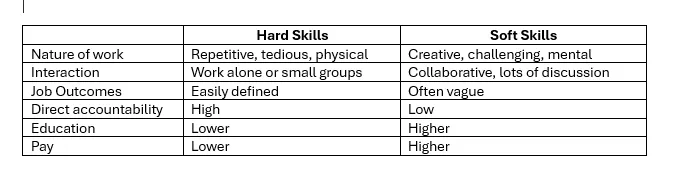
My life experience is that people who are predominantly on the hard-skill side have some contempt for the soft-skill side. The hard-skilled are less likely to recognize the importance of the skills of organizing, planning, analyzing, and problem-solving. According to many hard-skilled workers, “management” is easy — and many soft-skilled workers do not deserve their pay.
To many hard-skilled workers, most government workers are soft-skilled people (not quite true). So there is a natural contempt toward the government for this reason.
Let me put this in a different way. Many of the 77m Americans who voted for Donald Trump would be happy to fire 100 scientists at National Oceanic & Atmospheric Administration. But their reason is not because this federal agency is bloated or no longer serves a valuable function. But rather, these Americans just want to see well paid people lose their “cushy” government jobs. This is class warfare.
Bringing the points together
Let me put the previous points in a list:
1. Lazy civil servants
2. Coasting civil servants
3. Manipulating budgets
4. Inefficient operations
5. Bad decisions
6. Obsolete laws & departments
7. Bureaucratic empire building
8. Corruption
9. Bad balance
10. The class war
Long list, indeed. It makes government operations look inherently inefficient. If so, it would be better for citizens not to have government — if the main purpose of government seems to be giving government workers a paycheck.
In fairness, I could have refuted these points to some degree. For example, there are employees in the free market who are also coasting in their employment, just doing enough work not to get fired. But to keep this essay on the shorter side, let’s just say that human nature creates inefficiencies in both the free market and government operations. If the free market cannot deliver perfection, why should we expect perfection from the government?
As an outsider on the inner workings of government, I believe that 10% of government operations fall into this “inefficiency” list. The other 90% of government operations provide some degree of benefit to society — and have been appropriately determined through a legislative process.
On one hand, we could consider that 10% inefficiency is acceptable. So we should not fix a small problem. In fact, trying to fix that 10% might cause other inefficiencies, like bureaucrats watching over other bureaucrats.
On the other hand, this 10% of government inefficiency might be giving ammunition for right-wing thinktanks to rant that most government operations are indeed inefficient.
And the inability — or perceived inability — not to seek more efficient operations furthers the perception that government is inefficient.
And maybe I’m wrong. Maybe 50% of government activity is indeed inefficient — and the only way to cut out the rot is to cast aside the whole works.
Why is there such little accountability?
In theory, our elected politicians should be overseeing the many government departments. But there are good reasons why our politicians are not on top of these situations.
Our politicians are busy people. They often put in 80-hour work weeks. However, this time is mostly spent on politics, not governance. Politicians have party functions to attend, alliances to build, and angles of political intrigue to work out. And they attend public functions to show their connection to the people. There are legislative duties to fulfill. If the politicians don’t take care of their political business, their political party will find someone else.
The chance most politicians will be an effective overseer of any government department is small. They cannot solve problems outlined in the previous sections of this article because the system prevents them from participating in this way. In essence, our elected politicians are unaccountable in this regard. Our civil service is left mostly unsupervised.
And our legislatures are working in the 18th-century. Trying to implement new and effective laws is a burdensome process. There are good reasons why there is so much due process. But turning bills into laws mean other worthy bills are not introduced. So lingering issues remain unresolved — and continue to fester. We need 21st century legislatures.
The solution
In case you are not one of my lukewarm fans, I am an inventor of an alternative democracy: Tiered Democratic Governance (TDG). How will the TDG deal with inefficient activities of various departments in the civil service?
While I can’t specifically predict the techniques the TDG will use to supervise the civil service, I can provide the TDG features that allow the TDG representatives to be in more control.
1. There will be more citizens elected into the TDG. There will be more legitimate eyes to watch and more legitimate voices to speak to government operations. When the lower tiers of the TDG are somewhat unified in their observations, the higher tiers of the TDG will be compelled to conduct investigations.
2. The TDG representatives will not be spending time and energy on their re-election or needs of their political party. More of their time will be allocated to understanding what the civil service is actually doing.
3. The TDG representatives will be working with a consultative approach to decision making, not a combative approach. More time and energy can be spent observing the civil service than trying upend political rivals. So better supervision of the civil service is likely.
4. The TDG legislative processes will be streamlined. TDG governance will be more responsive to introducing new legislation and amending & repealing current laws that no longer work well.
5. The TDG representatives will be much more trusted than today’s politicians. With trust comes efficiencies — and respect for TDG decisions.
When the TDG is fully implemented, the elected TDG representatives will have much more control over the civil service. I think the TDG governance can get that inefficiency list down to 5%.
When the citizenry believes the most of the civil service functions well and is serving society, there will be less political force to deal with problems by firing the whole departments or reverting civil service functions to private enterprise.
Let me say this in another way. When the elected TDG representatives are on top of the civil service, the civil service will be widely regarded as a valuable component of society, not as a parasite. And that will produce a more positive relationship between the citizens and their government.
Published on Medium & Substack 2025
A Glimpse of Our Future Democracy
