

Don’t ask to explain it!
In 1998, I joined my first serious co-operative: the Credit Union of High River, Alberta.
Three years later, I joined my second serious co-operative: The Co-op of Calgary, Brooks branch.
This co-op had a grocery store and gas station in Brooks, Alberta. But somehow the finances of the Brooks branch and Calgary Co-op were not linked together. I never got a dividend, even though the Calgary Co-op was paying dividends to their members in Calgary.
I shopped at this co-op for four years. Then one day, the grocery store’s doors were closed. It must not have been profitable. That’s why I did not get a dividend. The Calgary Co-op sold the grocery building to another grocery chain. It sold the gas station to the Vauxhall Co-op.
I automatically became a member of the Vauxhall Co-op. And a year later, I got a dividend check. The Vauxhall Co-op must have been profitable. The statement said $15.00. But the check was about $5.00. The other $10 went for “equity.”
A year later, I got a similar statement and dividend check. I was a little curious, so I made a phone call to figure out why I did not get the full dividend. A fellow explained to me that a co-op member needs to have a $400 share to be fully vested. So until that share is purchased, one-third of the dividend gets sent as to the member and other two-thirds get put into purchasing that $400 share.
Well, that was how I understood things. While I was content with that understanding, the reality could be something different.
A little geography of Southern Alberta
I will talk about how certain co-ops merged. A map of Southern Alberta might help the reader understand these mergers. Included are the cities and towns (with their populations) in this story.
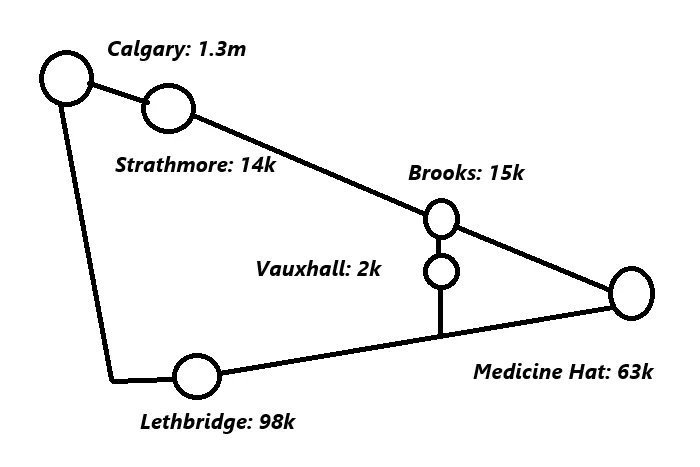
MAP TO COME LATER
The Vauxhall Co-op
At this time, the Vauxhall Co-op had five stores. In Vauxhall, there was a grocery store, an agro/hardware store, and a gas station. In Brooks, there was an agro/hardware store and a gas station. For me, Vauxhall was too far away to justify shopping there, so I never bought anything at these stores. Most of my co-op purchases were at the Brooks gas station, with a few things at the Brooks hardware store.
Most of the co-ops in this Western Canadian federation started locally. They were essentially independent, legal entities, overseen by the federation. This meant that when I bought from a Co-op store not under the Vauxhall Co-op, that purchase would not count toward my Co-op dividend.
The merging starts
About 2010, the co-ops in southern Alberta started merging. Unlike the merging of my Credit Union, I did not get much notice all the merging was happening. I mostly heard it from the local media and maybe a little mail notice from the merged co-op after it had merged. It seemed I had no say in this merger, but I probably would not have voted anyways. And besides, I was not fully vested and maybe that is why I didn’t get notifications and the right to vote.
By 2015, South Country Co-op encompassed about 40 stores in Southern Alberta. Most of these stores were present before the merging started. Medicine Hat and Lethbridge were the biggest centers. I could now purchase from these stores and have my purchase counted toward my Co-op dividend.
Calgary Co-op is still independent from South Country Co-op. The Strathmore Co-op is part of the Calgary Co-op. While I can still buy gas and groceries in these co-ops, these purchases do not count for my dividends.
Buying groceries
Medicine Hat has two Co-op grocery stores. Two years ago, I found myself in Medicine Hat more often. So I thought it was time to support my co-op grocery store more.
I made about 10 shopping trips to these Co-op stores. And I concluded that their prices are 10% to 15% higher than my usual grocery store in Brooks, which is the local Walmart. I found this a little strange as grocery prices are usually higher in rural areas, which have less competition and lower economies of scale.
Last year, I got a refund of 5% on my grocery purchases. So even with that dividend, the Brooks Walmart was cheaper than my Medicine Hat Co-op. I decided to be “less religious” with my co-op grocery store, preferring the prices and convenience of the Brooks Walmart.
I still make a shopping trip in the Medicine Hat co-op grocery stores every couple of months. With these trips, I confirm that prices are still at least 10% higher. And these stores have a few foods I like the Brooks Walmart will not carry.
I buy nearly all my gas at the gas bars of South Country Co-ops. I don’t compare gas prices. The Co-op won’t go beyond $0.04 a liter more than the other gas stations. So I can support a Co-op with that higher price. I suspect Co-ops gas prices are competitive.
Co-op advertising
My credit union is often advertising in local media outlets. This advertising’s purpose is mostly keeping members satisfied with their decision to bank at the credit union. Some advertising is purposed to minimize switching brands.
Compared to the credit union, the South Country and Calgary Co-ops are going overboard with advertising. I often wonder how much cheaper our food and gas could be if the Co-ops were not spending so much money on advertising.
But I’m not in the backrooms of co-op decision makers. I suspect grocery stores customers are more fickle than bank customers. Many grocery shoppers could change their preferred grocery store with a flashy marketing gimmick. The Co-op managers have a lot of data and experience to understand how sales are affected with advertising budgets. Maybe they are making the right decisions to keep the grocery stores viable. I don’t know.
Co-op & governance
This essay shows that I am fairly cavalier with my membership responsibilities in this co-op. I don’t understand how the South Country Co-op actually works, including its relationship with the Co-op federation. I have no idea of its current challenges and future plans. I just trust that the management people will make the right decisions at the right time.
I don’t have the desire to find out more. I have other things to do. In essence, I have assigned my responsibilities for Co-op governance to someone else.
Many political writers on Medium like to blame those voters who don’t take the time and effort to cast a wise vote. By “wise vote,” this means voting the same as the political writers.
If these writers were Co-op members, they would chastise me for not spending 10 hours a year casting my eye on what is happening with the South Country Co-op, time which is warranted given how much money I spend at this Co-op. The political writers would say my trust is naïve.
But I like it that way. I believe at least 95% of South County Co-op members have a similar mindset. We don’t want to read financial sheets and biographies of our executive leaders. Many of us just don’t want to give corporate world our money.
In a like manner, many citizens would like not to be so vigilant with their municipal, provincial, and federal government. They want politics to be less of a factor in their life. Yes, decisions still have to be made. But why all the drama?
If South Country Co-op and Connect First Credit Union can manage their affairs wisely without a lot of member vigilance and drama, why not western democracy?
My alternative democracy — Tiered Democratic Governance (TDG) — will give many citizens to take the luxury not to spend so much time on politics. The TDG will find the right balance for many societal issues, most of the time. Citizens need not be so concerned that their government is usually in error of some kind.
Think what can happen when we release this societal energy now going toward vigilance and drama.
Economics of the Co-ops
I estimate Medicine Hat has about 15 supermarkets. South Country Co-op owns only two of them.
And there are maybe 30 gas stations in Medicine Hat. South Country Co-op owns three of them.
When people complain about excessive profits of the petroleum, grocery, and banking industries, I just say: “Join the Co-op and Credit Union.”
While the two Co-op grocery stores are busy with shoppers, they could easily handle a 20% increase in traffic. With that increase, these two stores could lower prices and attract even more shoppers. Maybe set up in a third grocery store in Medicine Hat! Maybe try again in Brooks.
Let me say this in business jargon: if 5% of residents in Medicine Hat decide to shop more at the Co-op, the South Country Co-op would gain an “economy of scale.” It would earn a lot more profit.
It all starts with consumers making choices about which commercial entities are more socially responsible. With this criteria, Co-ops are a no brainer.
An Advanced Co-op
When I shop at the Co-ops or bank at my Credit Union, I find the workers friendlier than other retail outlets. This does not mean the other outlets fail in this regard; it seems to me that there is a little edge with my co-ops. But maybe I am biased. There might be a different dynamic when employees retreat to their coffee room.
Both my co-ops are customer-driven. That means the profits are returned back to the customers.
I would not consider that as fair. Employees also deserve some of the profits.
I have invented an alternative co-operative, where the investors, employees, customers, and suppliers share in the profits. Here is the first article about “the Spolu:”
With profits moving from spolu-to-spolu-to-spolu, the economy has increased its money supply without having increased public debt. Professional economists should have lots of fun projecting the money velocity when many businesses become spolus.
Conclusion
Join the co-ops when you have a practical chance. You are making a statement.
Two years ago, I joined on Mastodon, a Twitter clone. It has a rather interesting ownership/federation structure. Not really a co-operative. But for sure, not a corporation. I send a little money to it to keep it going. But don’t ask me to explain it.
Published on Medium & Substack 2025
Addendum
When United States started the tariff war against Canada, I decided to make a statement. I now do most of my grocery shopping at the Medicine Hat Co-op instead of the Brooks Walmart. The co-co-op is owned by average Canadians; Walmart is owned by rich Americans. And yes, I am paying 10% more.
